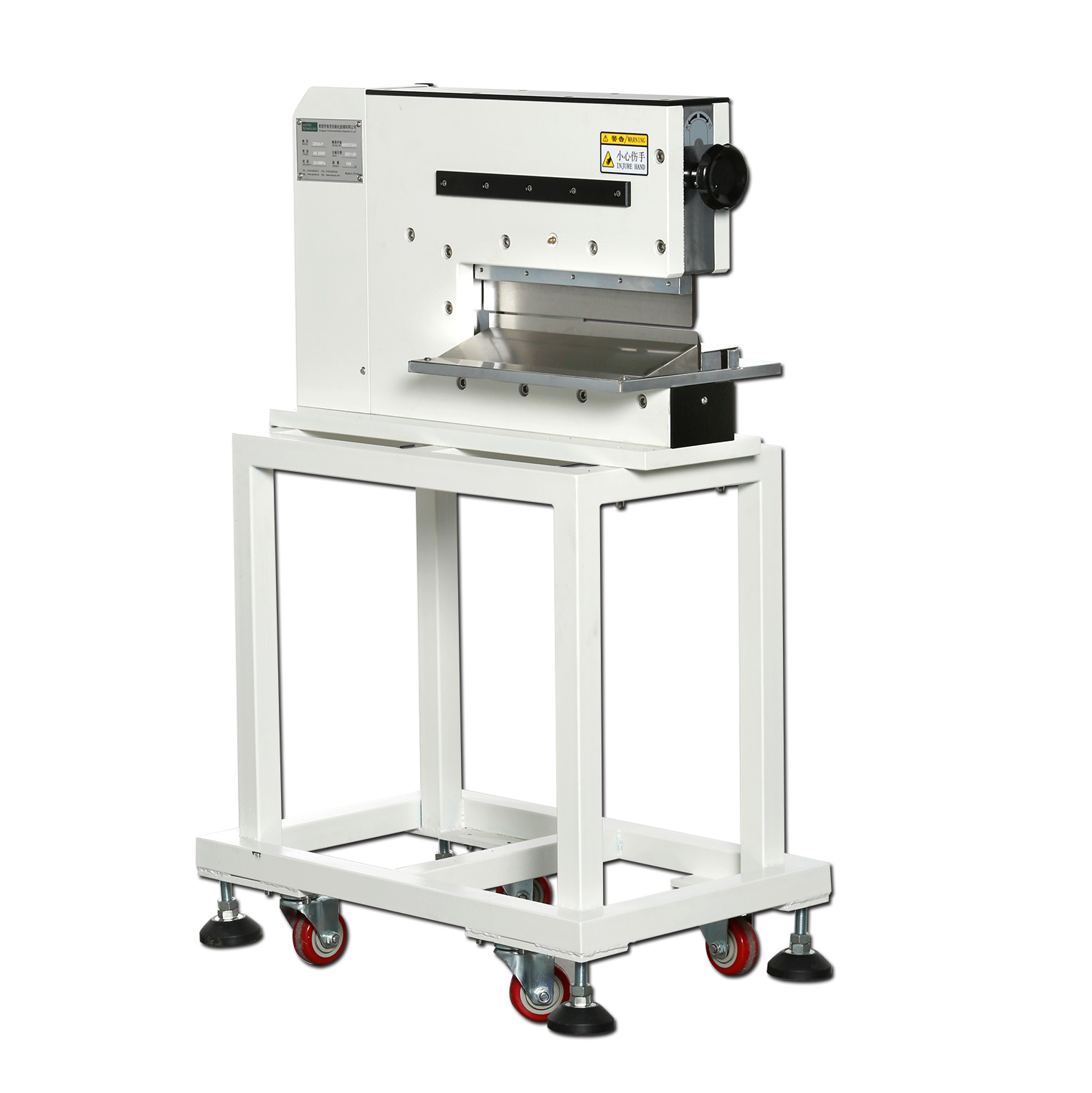
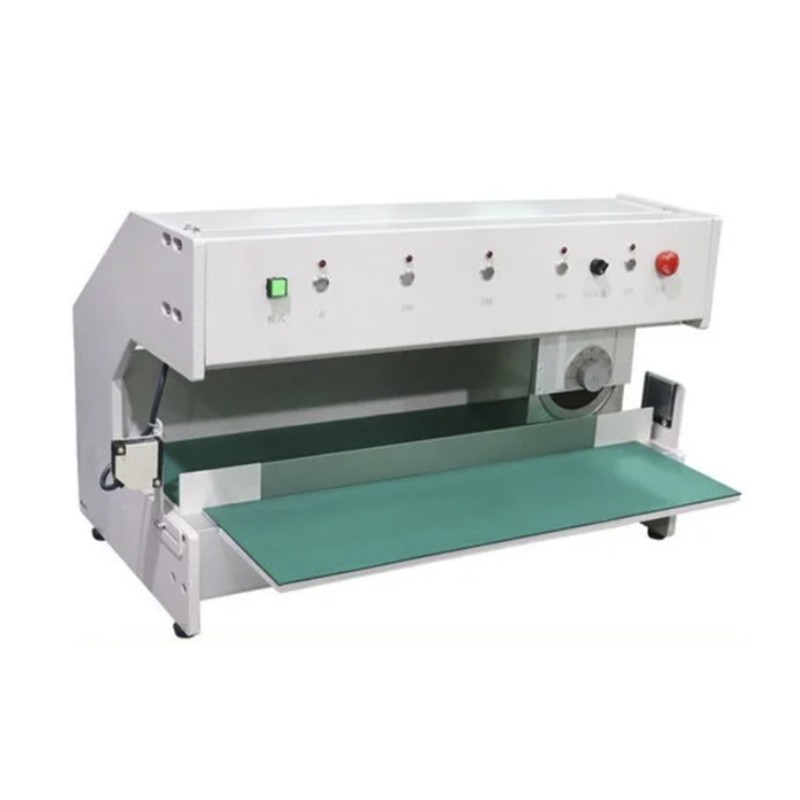
For low-volume, high-mix PCBA manufacturers, purchasing separate router and saw depaneling machines is not always necessary when production includes both stamp-hole panels and V-CUT panels.
A more practical solution is a hybrid PCB depaneling machine that combines router and saw cutting capabilities in one system.
Take the Genitec ZM300H as an example.
The ZM300H is not limited to processing panels that combine stamp holes and V-CUTs.
It can process:
Stamp-hole panels independently.
V-CUT panels independently.
Panels combining both stamp holes and V-CUTs.
For PCBA factories handling multiple product models and frequently changing production volumes, one ZM300H can cover a significant portion of the depaneling processes that would otherwise require two machines.
This can reduce equipment investment, production floor space, and material handling between machines.
The ZM300H uses independently controlled router and saw systems. According to its equipment specifications, it supports multiple panel designs, including stamp holes, V-CUTs, and process rails. It is also equipped with dual worktables and a CCD vision system.
In the past, many PCBA factories produced a relatively limited range of products.
A production line might run the same product, or just a few product models, for a long period of time.
In this situation, using a dedicated router depaneling machine or saw depaneling machine is usually straightforward.
However, product lifecycles have become shorter, while orders are increasingly fragmented.
A single factory may now produce:
Automotive electronics PCBA
Communication modules
Industrial control boards
Consumer electronics
New energy electronics
Different products may also use different panelization methods.
Some use stamp holes.
Some use V-CUTs.
Others use process rails.
Some panels even combine different connection methods on the same PCB panel.
This is where equipment flexibility becomes increasingly important.
According to recent industry information from Prismark, the global PCB market remains in a growth cycle. The global bare-board PCB market reached approximately US$85.8 billion in 2025, representing year-on-year growth of 16.7%.
AI infrastructure, data centers, high-speed networking, and automotive electronics are among the important growth drivers.
Prismark has also pointed to increasing demand for higher-layer-count, higher-density, and higher-value PCB products.
At the same time, IPC, one of the world's major standards organizations for the electronics industry, covers PCB design, fabrication, assembly, and quality control through its extensive standards system.
This reflects the increasingly mature process and quality requirements of modern PCB manufacturing.
For equipment purchasing, this creates an important shift:
The question is no longer simply whether a machine can depanel a PCB. It is also how many product types the machine can handle.
This is especially important for low- and medium-volume production.
Equipment utilization and changeover efficiency can sometimes be more important than simply pursuing the highest cutting speed.
Stamp-hole panelization is a common method used in PCBA manufacturing.
Individual PCBs are connected through a series of small holes.
During depaneling, these connection points need to be removed while maintaining good board-edge quality and minimizing the impact on nearby components.
This type of processing is generally well suited to router depaneling.
A router can follow the programmed contour of the PCB.
For example:
Straight lines
L-shaped paths
U-shaped paths
Arcs
Circles
Other customized contours
Different products can use different cutting paths through programmed recipes.
According to Genitec's equipment specifications, the ZM300H router supports straight-line, L-shaped, U-shaped, circular, arc, and point processing.
The specified router cutting accuracy is ±0.05 mm.
Therefore, if a factory mainly produces stamp-hole PCB panels, the ZM300H can be used as a router depaneling machine.
The saw system does not need to be used for this type of product.
The basic characteristic of V-CUT panelization is straightforward.
It is primarily used for PCB panels that require straight-line separation.
When a PCB panel has already been machined with V-grooves, using a saw blade to cut along the V-CUT is a common depaneling method.
Therefore, even if a factory mainly produces V-CUT panels, it does not necessarily need to purchase a dedicated saw depaneling machine.
The ZM300H includes an independent saw cutting system.
According to the equipment specifications, the saw supports straight-line processing, with an effective working area of up to 370 × 420 mm.
In practical terms:
Stamp-hole panels → Router.
V-CUT panels → Saw.
Stamp-hole + V-CUT panels → Router and saw systems used separately according to the process.
One machine can therefore cover all three production scenarios.
This is the practical value of hybrid depaneling equipment for low-volume, high-mix PCBA manufacturers.
Many purchasing teams initially focus on the purchase price of the equipment.
However, the total cost of ownership should include more than the machine itself.
If a factory purchases:
One router depaneling machine
One saw depaneling machine
It also needs to consider:
Machine footprint.
Operators.
Fixtures.
Loading and unloading space.
Equipment maintenance.
Electrical and pneumatic requirements.
Material transfer between machines.
Changeover and production management.
For high-volume, single-product manufacturing, these costs can often be absorbed through high equipment utilization.
But in low-volume, high-mix production, machines may not operate at full capacity all the time.
Two machines dedicated to different processes may therefore have relatively low utilization.
In this situation, a machine that combines two depaneling processes can potentially achieve better overall utilization.
The basic concept behind the ZM300H is straightforward.
The router system handles routing operations.
The saw system handles straight-line cutting.
The two systems are independently controlled.
The machine uses dual worktables, allowing alternating operation and reducing loading and unloading waiting time.
According to the product specifications, the effective working area is 370 × 420 mm.
For high-mix production, this design can be particularly practical.
Product A uses stamp holes.
→ Call the router program.
Product B uses V-CUTs.
→ Call the saw program.
Product C combines stamp holes and V-CUTs.
→ Use the corresponding router and saw programs.
When the product process changes, there is no need to transfer the job to another machine simply because the depaneling method has changed.
This is an important factor that is often overlooked when selecting depaneling equipment.
If a factory produces only one product per day, maximum cutting speed is naturally important.
But if the factory needs to switch between five, ten, or even more PCBA models every day, the priorities change.
Engineers are more likely to ask:
Can programs be recalled easily?
Is positioning stable?
Are fixtures easy to change?
Does changing the process require extensive machine adjustment?
Can production resume quickly after switching products?
The ZM300H is equipped with a CCD vision correction system and supports Mark-point positioning and multi-Mark recognition.
The vision system can identify reference points and compensate for positional deviations.
For high-mix manufacturing, this type of flexibility can be more valuable than simply promoting high cutting speed.
Depaneling is not finished simply because the PCB has been separated.
The quality of the separated boards also matters.
Key factors include:
Board-edge smoothness
Burr formation
Residual dust
Mechanical stress
Electrostatic discharge risks
All of these factors can ultimately affect PCBA quality.
IPC's acceptance standards for electronic assemblies also place significant emphasis on appearance, quality, and acceptability.
Therefore, when evaluating depaneling equipment, suppliers should not only be asked to demonstrate whether the machine can cut a PCB.
It is better to provide actual production boards for testing.
The test should replicate real production conditions, including:
Actual PCB thickness
Actual panelization
Actual component layout
Actual production cycle time
This provides a much more reliable basis for equipment selection.
According to Genitec's equipment specifications, the ZM300H is more than simply a router and saw mounted on the same machine frame.
It incorporates several functions designed specifically for PCBA depaneling.
Supports Mark-point positioning, multi-Mark recognition, and vision-based compensation.
The two worktables operate alternately to reduce loading and unloading waiting time.
The router spindle can reach speeds of up to 100,000 rpm.
The system can be equipped with a 6 HP external dust collector for collecting dust generated during depaneling.
The machine incorporates static elimination functions to reduce electrostatic risks during the depaneling process.
Supports tool-life management, automatic tool changes, and broken-tool detection.
The machine can exchange production data with MES systems and use barcode scanning to identify product information and detect defective products from previous processes.
Together, these functions form a hybrid depaneling solution designed for modern PCBA production.
The ZM300H is worth considering if your factory falls into one or more of the following categories.
You have many product models, but the production volume of each model is relatively limited.
You do not need to prepare separate machines for the two depaneling processes.
One day you may process stamp-hole panels.
The next day, V-CUT panels.
Later, you may encounter panels combining both processes.
You want to perform more production tasks within a limited manufacturing area.
Purchasing separate router and saw depaneling machines means investing in two machines with partially overlapping functions.
A hybrid router-and-saw machine consolidates both processing capabilities into one system.
There is an important point to clarify.
The advantage of a hybrid machine is greater process flexibility.
It does not mean that every PCB should be routed, or that every PCB should be saw-cut.
The appropriate process should be selected according to:
PCB panelization
PCB material
Board outline
Component layout
Required depaneling accuracy
Edge-quality requirements
A simple guideline is:
Stamp-hole panel → Generally consider router depaneling first.
V-CUT panel → Generally consider saw depaneling first.
Stamp-hole + V-CUT panel → Use router and saw processes according to the respective features.
Low-volume, high-mix production → Hybrid equipment can provide greater flexibility.
The objective of equipment purchasing is not to buy the most expensive machine.
It is to buy a machine that covers the actual range of products your factory needs to process.
For high-volume, single-product manufacturing, dedicated equipment can often deliver excellent efficiency.
But for low-volume, high-mix PCBA production, equipment flexibility becomes increasingly important.
A single machine that can handle:
Stamp-hole panels.
V-CUT panels.
Panels combining stamp holes and V-CUTs.
can reduce the need to switch between different machines when product requirements change.
The Genitec ZM300H uses independently controlled router and saw systems, with an effective working area of 370 × 420 mm and specified router cutting accuracy of ±0.05 mm.
It also integrates CCD vision, dual worktables, dust collection, ESD protection, automatic tool changing, broken-tool detection, and MES-related functions.
For companies considering the purchase of both a router depaneling machine and a saw depaneling machine, it is worth doing a simple calculation first:
Do you really need two machines if both processes are required?
If your production is low-volume and high-mix, can both machines maintain sufficient utilization?
If factory space is limited, is it worthwhile to dedicate additional floor space to two machines?
If the answer is not clear, a hybrid router-and-saw PCB depaneling machine deserves a place on your equipment evaluation list.
The positioning of the ZM300H is straightforward:
One machine. More PCB depaneling processes.
For high-mix manufacturing, that flexibility can often deliver more practical value than simply pursuing the maximum speed of a single depaneling process.
No.
The ZM300H can process stamp-hole panels independently, V-CUT panels independently, and panels that combine both types of connections. Its router and saw systems are independently controlled.
A router is generally more suitable for stamp-hole panels because it can follow customized PCB contours and process stamp-hole connections, process rails, and irregular board outlines.
Yes.
The ZM300H includes an independent saw cutting system designed for straight-line cutting and can be used for V-CUT panel depaneling.
Different products can use different depaneling processes.
One machine can cover stamp-hole, V-CUT, and certain mixed-process applications, reducing equipment changes and material transfers between machines.
It depends on the actual products.
If the factory's products mainly fall within the processes supported by the ZM300H, one hybrid machine can cover depaneling requirements that might otherwise require two different machines.
However, actual product testing is still recommended before making the final purchasing decision.
According to the equipment specifications, the effective working area is 370 × 420 mm, with a dual-worktable design.
For low-volume, high-mix PCBA production, the key advantage is not simply combining two processes.
It is the ability to cover more product types with one machine while reducing duplicate equipment investment, floor space, and material transfer.
Important factors include effective working area, router and saw cutting accuracy, CCD positioning, depaneling stress, dust collection, ESD protection, tool management, changeover procedures, and MES integration.
Most importantly, the machine should be tested with actual production PCB samples before purchase.