PCB Depaneling Method Selection: A Comprehensive Guide for Optimal Results
In PCB manufacturing, selecting the right depaneling method directly impacts product quality, cutting efficiency, and equipment investment costs. The two most common mainstream methods – the Router Depaneling Machine and the Circular Blade Depaneling Machine – perform very differently depending on the application.
Drawing on Genitec/Seprays's years of industry project experience, this article provides a systematic comparison across multiple dimensions: process characteristics, industry case studies, cost structures, and mass production performance. It also includes real-world application examples to help manufacturers make a scientific choice for their depaneling needs.
I. Process Characteristics of the Two Depaneling Methods
1. Router Depaneling
Router depaneling uses a high-speed rotating bit to perform contour cutting. It is particularly suitable for PCBs sensitive to mechanical stress or those with complex, irregular shapes.
Key Advantages:
Minimal to zero stress cutting, preventing damage to components.
Capable of curve and complex contour processing.
High precision with smooth cut edges.
Programs can be quickly edited, ideal for high-mix production.
Ideal Applications:
"High-Precision Depaneling," "Stress-Free Depaneling," "Irregular PCB Cutting," "Automotive Electronics Depaneling."
2. Circular Blade Depaneling
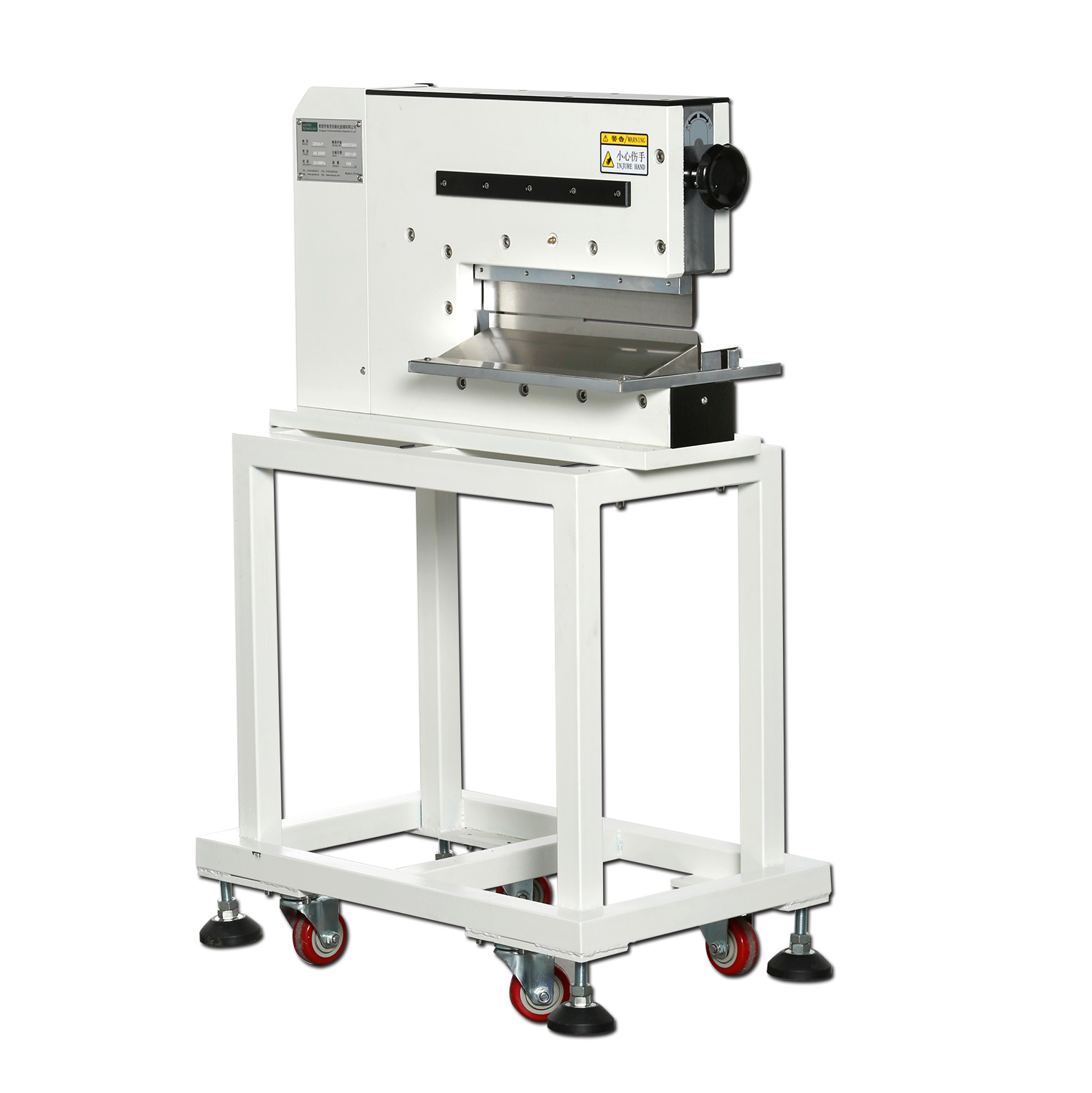
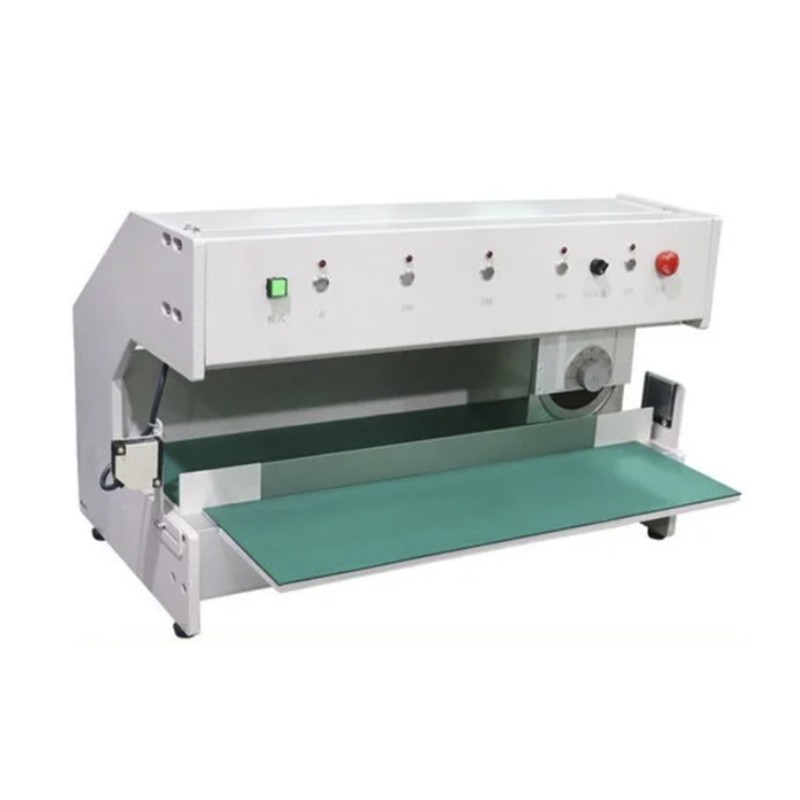
Circular Blade depaneling uses a rotating blade for high-speed straight-line separation of V-scored substrates. It is one of the highest-throughput depaneling methods available.
Key Advantages:
Extremely fast cutting speed, typically 2–5 times faster than routers.
Long tool life and low consumable cost.
Excellent for standard straight-line V-cuts.
Delivers very high-quality cuts for V-scored PCBs.
Ideal Applications:
"V-cut Depaneling," "High-Speed Depaneling," "High-Quality Depaneling," "High-Volume Production."
II. Application Case Studies
Case 1: LED Light Panels (Straight Lines, Multi-up Panels, High Volume)
▶ Recommended: Circular Blade Depaneling Machine
LED light panels often use a long strip layout with primarily straight V-cuts. This type of product demands extremely high throughput and stability.
Circular Blade Advantages:
Sustained high-speed cutting, suitable for 24/7 mass production.
Lowest cost per cut; each blade can last for tens of thousands of meters.
Easily integrated with SMT/through-hole lines for full automation.
Case 2: Automotive Electronics Large Panels (High Reliability, Thick Boards)
▶ Recommended: Router Depaneling Machine
Automotive electronics require minimal stress cutting. Tool path design is critical, especially near sensitive areas like BGAs, gold fingers, and filter capacitors.
Router Advantages:
Minimal stress helps prevent hidden micro-cracks.
Supports complex contour machining around components.
Cutting path accuracy can reach up to ±0.05mm.
Feedback from Genitec/Seprays:
A Tier 1 supplier reported an 80% reduction in BGA micro-cracks after switching to router depaneling.
Case 3: Communication Motherboards (Sensitive RF Areas)
▶ Recommended: Router Depaneling Machine
Communication equipment, like routers and base station boards, often contain large antenna areas sensitive to both mechanical stress and dust contamination.
Router Advantages:
Tool paths can be programmed to avoid RF transmission lines.
Extremely low cutting vibration, preventing impact on antenna performance.
Integrated dust extraction systems effectively control debris.
Case 4: Consumer Electronics (High-Mix, Low-Volume, Frequent Changeovers)
▶ Recommended: Router Depaneling Machine
Consumer electronics, such as earbuds, smartwatches, and smart home devices, have fast iteration cycles and a wide variety of products.
Router Advantages:
Quick product changeover via program adjustment.
Fixture-free models eliminate the need for custom jigs.
Ideal for flexible OEM/ODM production lines.
Case 5: Appliance Control Boards (Simple Geometry, Cost-Sensitive)
▶ Recommended: Circular Blade Depaneling Machine
These products typically have a regular shape, are produced in high volumes, and are highly cost-sensitive.
Circular Blade Advantages:
Low blade consumable cost.
High speed significantly reduces cost per unit.
Low maintenance requirements, suitable for widespread factory deployment.
III. Router vs. Circular Blade: Application Summary
| Application Scenario | Recommended Solution | Primary Reason |
|---|---|---|
| High-Volume Straight V-cut (LED/Appliances) | Circular Blade | Fastest speed, lowest cost, easy automation |
| Irregular Shapes, Contour Cutting | Router | Flexible tool paths, processes any shape |
| High-Value PCBA (Automotive) | Router | Stress-free cutting, protects components |
| RF/Antenna Sensitive Products | Router | Low vibration, programmable avoidant paths |
| High-Mix, Low-Volume & Mixed Lines | Router | Fast program switching, no custom fixtures |
| Cost-Sensitive, Simple Geometry | Circular Blade | Long tool life, high speed |
IV. Genitec/Seprays's Depaneling Machine Selection Advice
The final choice should be based on your PCB panel design, required efficiency, and quality standards:
Straight/V-Score Panels → Choose Circular Blade Depaneling
Breakaway Tabs, Complex Shapes → Choose Router Depaneling
Micron-Level Ultra-High Precision → Choose Laser Depaneling
Standard V-Cut, High-Volume Straight-Line Production → Choose Multi-Blade Gang Depaneling Systems
Many other factors can influence the decision. The scenarios listed above are not exhaustive.
Need help selecting the right machine?
Contact our technical experts at Genitec/Seprays for a personalized recommendation.
Hotline: +86 139 2926 8485